
Finding Plymouth Residents Carefully
Plymouth does not maintain one complete roll of everyone who lives in town. The strongest current path begins with a Plymouth parcel, then moves to a Plymouth County deed or a limited Commonwealth lookup that matches the question. A property card can identify an owner of record, a mailing address, a situs address, a parcel key, value fields, and a book and page reference. It does not establish every occupant of the property. A registry hit identifies parties to a recorded instrument, not a roster of residents.
Match the record type to the purpose. A Plymouth voter-status result is a narrow individual check, while an older Plymouth directory or newspaper item is evidence of a dated association. Keep the dates beside each result. That practice prevents an old mailing address, a recent assessment entry, and a historical directory entry from being blended into one unsupported claim.
- Search Plymouth Assessors by owner, parcel, street name, or street number and save the fiscal-year label, parcel ID, situs, and mailing address separately.
- Use the book and page, name, town, or date to search the Plymouth County Registry of Deeds and inspect the recorded image.
- Use the Massachusetts individual voter tool only for its stated first-name, last-name, date-of-birth, and residential-ZIP route.
- For a past Plymouth connection, request the relevant State Library directory year or use Plymouth Public Library newspapers, yearbooks, maps, and local collections.
- When an existing municipal record is not online, send Plymouth a narrow Massachusetts Public Records Law request that names the record class, date range, and department.
Plymouth Residents Directory Custodians
The records behind Plymouth resident research sit with different custodians. Plymouth Assessors maintain the assessment file. The Plymouth County Registry records land instruments. The Town Clerk handles elections and local lists, subject to statutory limits. Those divisions matter because a Town of Plymouth result is narrower than a Plymouth County result, and a statewide search may require a town, court, or board selection before it has local meaning.
Start with the office that controls the record, not an unsourced copy. The cards below provide the main Plymouth routes for present parcel work, recorded land, and individual voter registration status.
Plymouth County Registry of Deeds
50 Obery Street
Plymouth, MA 02360
508-830-9200
Town of Plymouth Assessors
26 Court Street, second floor
Plymouth, MA 02360
508-747-1620 x10296
Plymouth Town Clerk Elections
26 Court Street
Plymouth, MA 02360
508-322-3433
Plymouth Parcel Search Fields
The Plymouth Assessors advanced search is a useful first stop when an address is known. Its fields include Parcel, Owner, Street name, Street num, Building type, year-built range, beds, baths, lot size, finished-size range, land-use code, neighborhood, total-value range, sale-price range, sale-date range, Book, and Page. Street name and street number are separate controls. A Plymouth street-name pass can locate the group of parcel cards before a number narrows the result.
A Plymouth card connects a parcel to a tax-cycle record. It can show a current owner of record, property location, mailing address, legal reference, sale, assessed components, and building characteristics. Under the Town's January 1 assessment rule, a later buyer may not appear until the next fiscal year's first quarter. The card should therefore be dated and read as an assessment record, not a direct statement that a named person currently occupies a Plymouth address.
For a full address-by-address record trail, the separate Plymouth street directory follows the parcel, map, and deed sequence in more detail.
Plymouth Deed Index Continuity
The Plymouth County Registry's TitleView portal is the recorded-land route for deeds, mortgages, plans, liens, homesteads, and registered land. Recorded Land offers name, book, unindexed-book, date-range, document, and property searches. The portal also separates Registered Land, Plans, and Plymouth Colony material. A failed Plymouth name search should lead to another documented search path, such as a book search, date range, property search, or historic grantor and grantee index, rather than a conclusion that no record exists.
The TitleView portal displays the Plymouth County Registry search menus and recorded-land choices used to move from an index result to a document image.
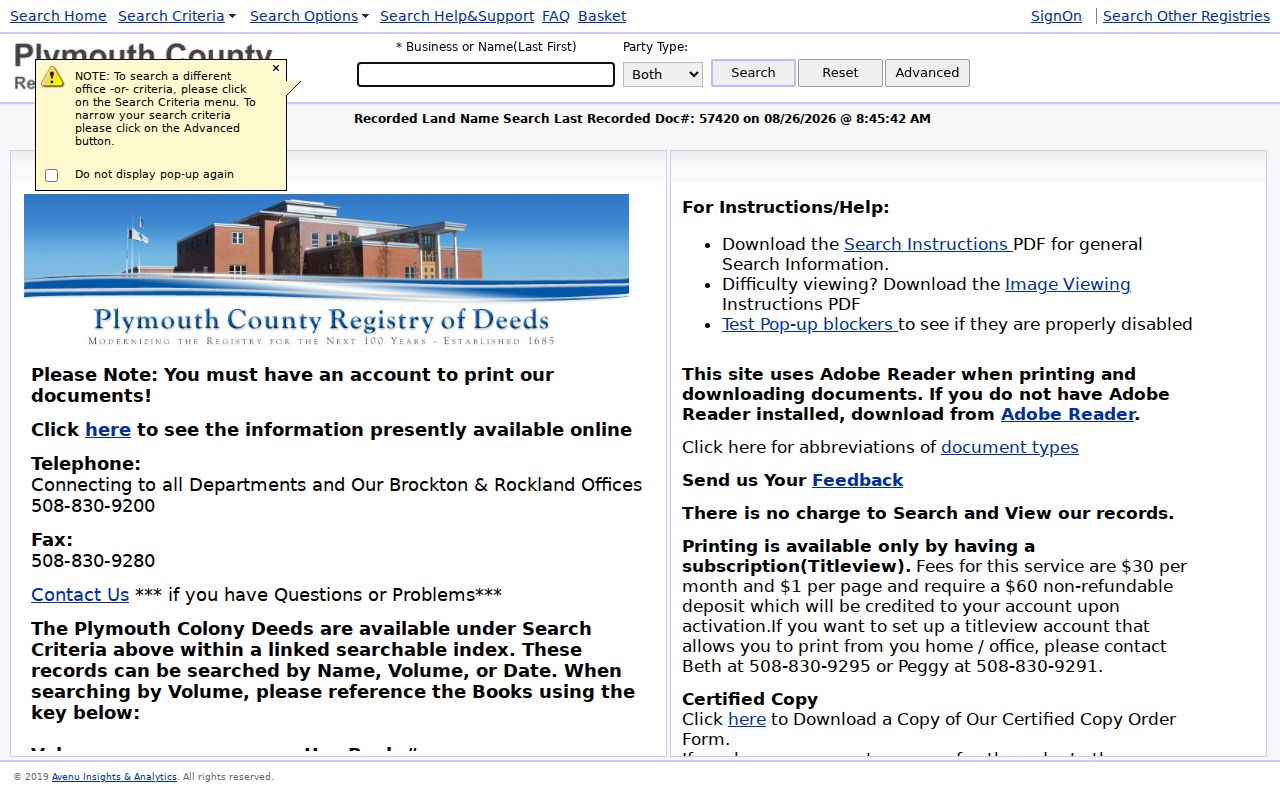
TitleView makes searching and viewing free, while printing requires a subscription arrangement, per-page cost, and deposit described by the Registry. The historic menu lists grantor and grantee indexes from 1685 to 1969, with back-indexing ongoing, and the Registry inventory identifies record books from 1686 onward. Plymouth Colony volumes reach the 1620 period, but a colonial reference is historical context, not a modern chain-of-title conclusion.
Current Plymouth Residents Directory Sources
Current Plymouth resident sources have different audiences and limits. The assessor file is tied to parcels and ownership. The individual voter tool verifies registration status when its required details are supplied. Registry results name parties to instruments. A Town voter list follows a different public-access process and excludes confidential and nonpublic fields. The table separates these sources so a Plymouth search does not promise more than each route can show.
| Plymouth source | Connection shown | Custodian | Access boundary |
|---|---|---|---|
| Assessment file | Owner of record, parcel, situs, mailing address | Plymouth Assessors | Online annual file; owner is not occupant |
| Individual voter lookup | Registration status for one person | Massachusetts Secretary | Name, DOB, and residential ZIP; not bulk access |
| Local voter list | Name, residence, party, status | Plymouth Town Clerk | Request process and confidentiality exclusions |
| Recorded-land index | Grantor, grantee, or other instrument party | Plymouth County Registry | Free search/view; party is not resident proof |
| Town records request | Defined existing municipal record class | Plymouth RAO | Exemptions, redactions, fees, and response rules |
Plymouth research is most reliable when it identifies the narrow relationship each record supports. Use an assessor card for a fiscal-year owner-of-record statement, a Registry image for a recorded-party statement, and a voter result only for status at the time searched.
Plymouth Voter Lookup Inputs
Massachusetts provides an individual voter-registration lookup, not a Plymouth-wide downloadable directory. The official tool asks for the registration spelling, date of birth, and a five-digit residential ZIP. Its search tips say a nickname may be needed, an old residential ZIP can help after a move, and a new registration may take two to three weeks to appear. A Plymouth result still needs a source date because registration status is not proof of ownership or present contactability.
Massachusetts voter registration search is the official screen for the following Plymouth-relevant search fields.
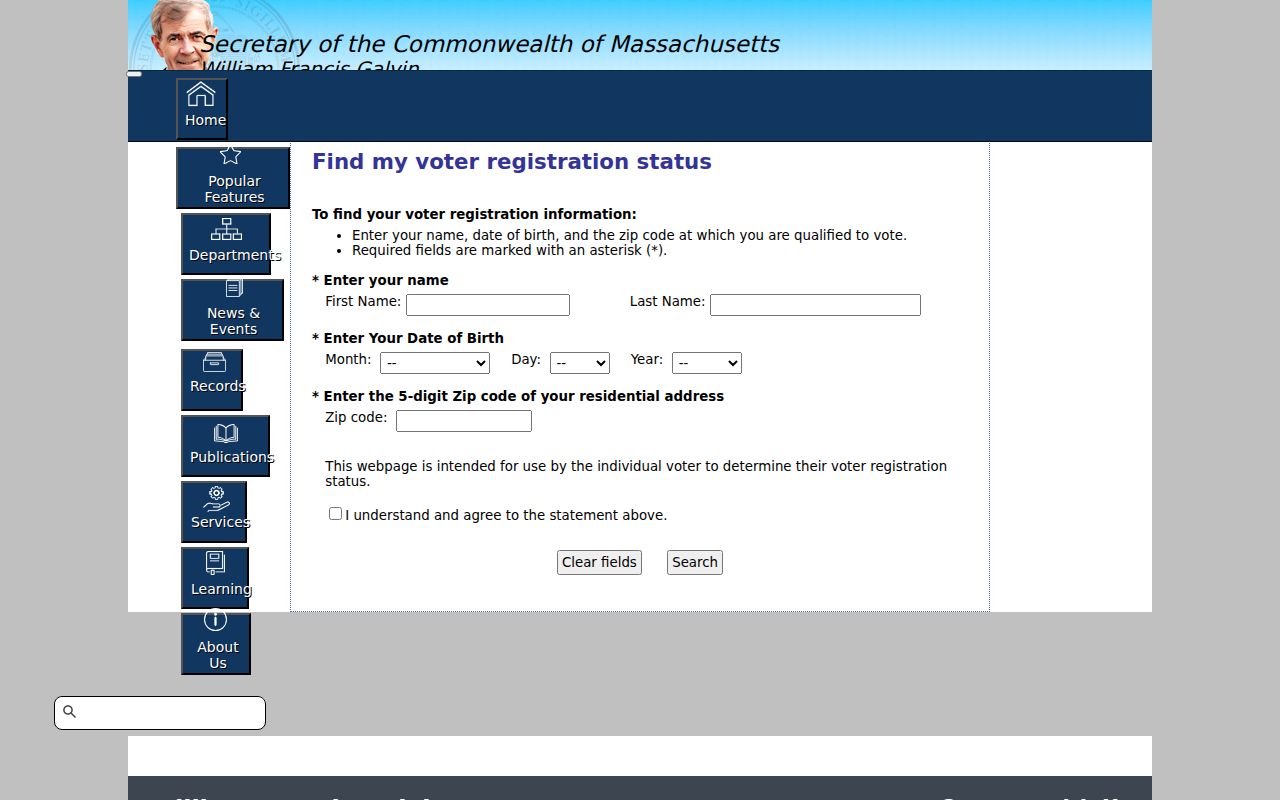
The tool is deliberately narrow. For an available dated municipal list, contact the Plymouth Town Clerk and ask for the list type, date, allowed fields, format, and production cost. Phone numbers, email, veteran status, permanent-absentee status, confidential-voter information, and minors' information are not ordinary public-list fields.
| Official field | Required | Format | Plymouth search note |
|---|---|---|---|
| First Name | Yes | Text | Use the registration spelling; a nickname may be needed. |
| Last Name | Yes | Text | Try supported spelling variations carefully. |
| DOB month, day, year | Yes | Dropdowns | All three parts are required by the official tool. |
| Residential ZIP | Yes | Five digits | An earlier residential ZIP can help after a move. |
| Agreement checkbox | Yes | Checkbox | Confirms the tool's displayed statement. |
Plymouth Court Record Boundaries
MassCourts is a separate Plymouth route for public court dockets. The portal asks for Court Department and Court Division, with Court Location when applicable, before a name, case type, case number, or ticket search. In the civil name path, last name and first name are required, and the official instructions describe optional middle name, suffix, party type, case type, case status, date ranges, and result-count controls. A case-type date range is limited to 30 days, while a case-number search depends on capitalization, spacing, and leading zeros.
MassCourts eServices is the official public-search entry point for Plymouth District Court and Plymouth Probate and Family Court matters.
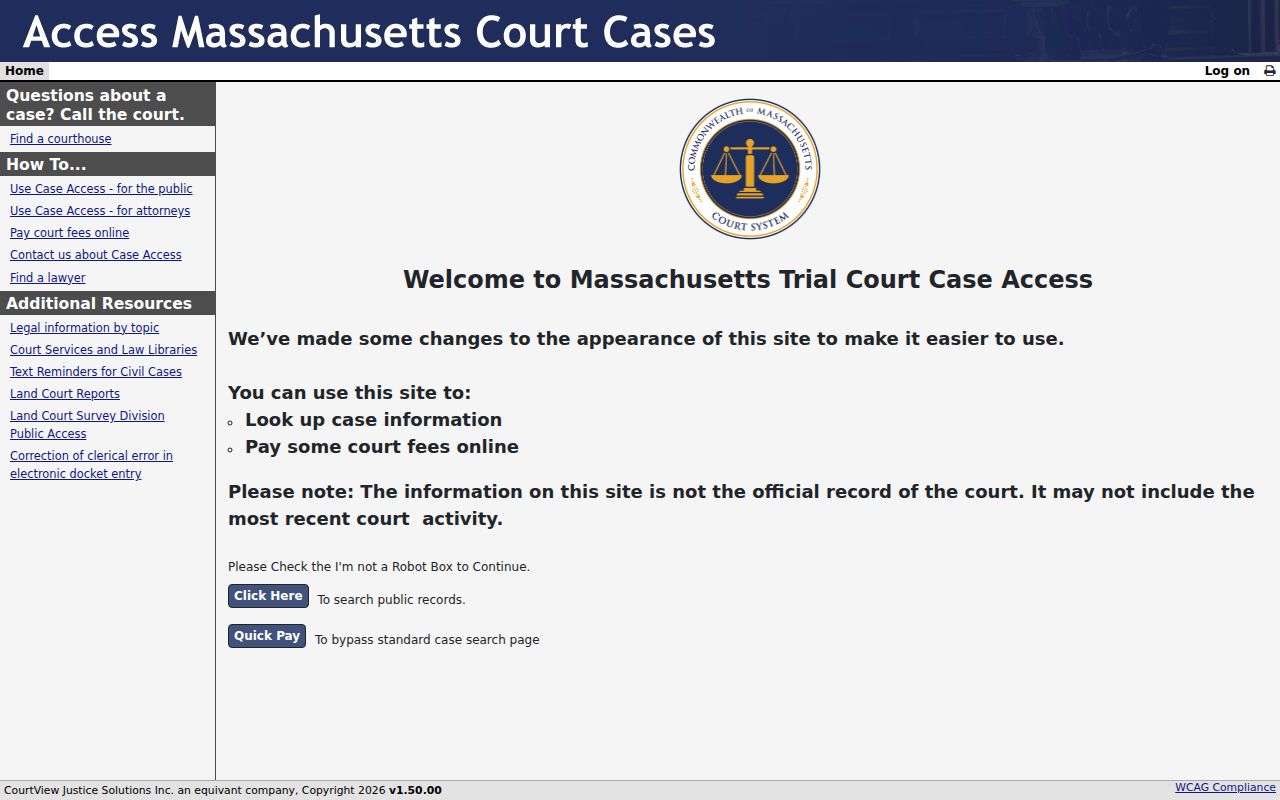
A Plymouth court hit can concern a party from one of several communities served by a court division. It is not a residence finding. Remote access also excludes or limits juvenile, sealed, impounded, and other protected material. The clerk or courthouse terminal is the next route when the public file, a physical record, or a certified copy is needed.
Plymouth Records Request Route
When a Plymouth portal does not display the needed existing record, the Town's Records Access Officer process is the proper fallback. Massachusetts Public Records Law, G.L. c.66 §10, allows requests for existing municipal records, not a request for every fact about a person. Plymouth's RAO guidance identifies FOIADirect as the preferred route and also describes first-class mail, email, and in-person submission. A focused request names the record, date range, subject or property, and the department that likely holds it.
Plymouth's response target is 10 business days, subject to the law's fee, exemption, and redaction rules. A request for a dated permit report, an agenda, an inspection record, or an available voter list is more useful than a broad personal-information request. The Town can redact exempt portions rather than release sensitive material, so a partial response may be the correct legal result.
Plymouth Source Comparison
Official Plymouth records and commercial data products answer different questions. The former identify a custodian, date, field set, and access boundary. Commercial products can merge old addresses and roles, so they should not replace a Plymouth assessor card, a Registry image, a court clerk, a voter-protection rule, or USPS validation. Compare two independent source categories with compatible dates before describing a person as associated with Plymouth.
| Research choice | Strength | Limit to keep |
|---|---|---|
| Official Plymouth or Massachusetts record | Named custodian, known purpose, source date, and stated access rule | May be dated, incomplete, redacted, or limited to a record role |
| Registry index plus image | Links an index lead to the recorded instrument | Shows document parties, not household occupancy |
| Commercial data category | May suggest a term to verify elsewhere | Can be stale or merged; do not treat it as evidence |
Free access is not the same as unrestricted use. Plymouth Registry searching and image viewing are free, but printing follows the Registry's stated subscription and per-page arrangements. A public result remains subject to its context, date, and confidentiality limits.
Plymouth Record Terms Defined
Plymouth resident research is easier when labels are kept in their original sense. A field that looks like an address may be the parcel situs, a mailing address, or an address used for a different administrative purpose. The terms below help keep a Plymouth result tied to the record that actually produced it.
- Parcel
- The Plymouth assessor's property key, often expressed through a map, block, lot, or parcel identifier.
- Situs address
- The physical Plymouth property location. It can differ from the owner's mailing address.
- Index
- A searchable finding aid, such as the Registry's name or book search, that should lead to the image or controlling record.
- Roll
- A dated list maintained for a defined public purpose, not a complete list of every Plymouth resident.
- Grantor and grantee
- The parties shown in a recorded conveyance. Their document roles do not by themselves establish residence.
Plymouth Privacy Protections
Plymouth searches must stop at privacy boundaries. Massachusetts Address Confidentiality Program participants can use a substitute address. Confidential voter registration can withhold a name and address from ordinary public lists under the applicable rules. Court records can be sealed or impounded, and vital records have eligibility, closure, and identifier limits. An absent, redacted, or substituted field is not an invitation to infer the protected information from another source.
Keep only the detail needed for the question. Do not republish date of birth, voter ID, phone number, email, signature, SSN, protected address, or unnecessary family and court detail. If a Plymouth record exposes more than is needed, retain the official route and the minimum fact that can be responsibly stated.
Historical Plymouth Directory Trails
Historical Plymouth directory work belongs in the dated collections, not in a current lookup. The Massachusetts State Library inventory identifies Plymouth directories for 1887-1888, 1890, 1893, 1896, 1898-1899, 1900, 1901, 1903, 1905, 1907, 1909, 1911, 1913, 1915, 1917, 1919, 1921, 1924, and 1932. It also lists Plymouth voting lists for 1924, 1953-1956, 1958, 1959, and 1980, plus a 1960 pocket directory and a 1974 PSP Blue Book.
Plymouth Public Library supplies local context through the Bartlett Room, History Room, town reports, maps, photographs, high-school yearbooks, Old Colony Memorial access, and digital collections. Ask for the title page, exact entry, page, and any house guide when requesting a Plymouth directory scan. The publisher and sample-entry field sequence were not confirmed for the listed Plymouth volumes, so they should be read from the item itself.
The focused Plymouth city directory page explains the historical shelves and how to compare a household across editions without treating a missing name as proof of absence.
Plymouth Library History Layers
Plymouth's local collections can add a date and setting to a records trail. The public library's digital runs include town annual reports from 1636-1783 in three volumes and from 1865-2023, high-school yearbooks from 1930-2024 except 1932 and 1948, and Cordage News from 1945-1954. The History Room also has a Historic Houses Collection from a 1992-1995 Massachusetts Historical Commission survey, arranged by place with a street-name index.
Those Plymouth sources are useful for a historical association, a street spelling, a building clue, or community context. They are not proof of current residence. An obituary should be preserved with issue, date, and page, then checked against a permitted vital or cemetery source. A house-history file should be paired with a deed, directory, assessor field, or primary architectural source before a Plymouth property history becomes a firm statement.
Plymouth Records Across Centuries
Plymouth has an unusually long chain of surviving record routes. TitleView's Plymouth Colony collection reaches the early settlement period, while historic grantor and grantee indexes begin in 1685 and selected Plymouth directories begin in 1887. The Registry inventory identifies record books from Book 1 in 1686, plans from 1890, and registered-land material from 1899. Each Plymouth source has its own coverage and gaps, so continuity comes from a documented series, not from one search screen.
For historical orientation, Town Square and Leyden Street help explain why older Plymouth civic material clusters near the town center. The 1891 nine-sheet Sanborn map set, historic property-card fields, and the library's house files can add a dated physical setting. Keep the record type visible: an assessor style or year-built field is an appraisal clue, while a Registry image, Sanborn sheet, or archival file supplies a different kind of evidence.
Note: Plymouth Registry reports and indexing standards can change, so record the access date whenever an image, field, or coverage claim is used.