
Plymouth Previous Residents by Era
Before naming previous residents of a Plymouth address, make a Plymouth era table. Plymouth records do not form one continuous household file. The Plymouth Registry gives recorded-land continuity, while Plymouth directories, maps, probate, and library files answer narrower questions for particular periods. A gap matters. Do not turn an uninspected Plymouth index, missing directory year, or later Plymouth assessor field into a seamless story. The table separates the strongest documented Plymouth routes and shows where an in-person or appointment-based step may still be needed.
| Plymouth historical source | Documented years | Where held | What it can establish |
|---|---|---|---|
| Plymouth Colony material | 1620s–1694 | Plymouth Registry TitleView and Plymouth Registry reading room | Colonial conveyance or order context after image and volume verification. |
| Plymouth historic grantor/grantee index | 1685–1969 | Plymouth County Registry TitleView | A party-to-instrument lead, not the deed image itself. |
| Plymouth historic probate | Index 1685–1939; dockets 1685–1967 | Massachusetts historic-probate route | Estate or guardian lead that may connect to Plymouth property. |
| Plymouth Sanborn maps | 1891; later dates cited through 1961 | Library of Congress and Plymouth Town historic report | Plymouth building footprint, use, street name, and dated context. |
| Plymouth directories | Selected years 1887–1932 | Massachusetts State Library | Dated name/address lead; entry fields remain edition-specific. |
| Plymouth Historic Houses Collection | 1992–1995 survey | Plymouth Public Library History Room | Historic name, builder, architectural description, and Plymouth resident clues. |
| Plymouth current assessor and GIS | Current release; annual or layer dates vary | Plymouth Town Assessors and Plymouth GIS | Modern Plymouth parcel, legal-reference, and spatial cross-check. |
Older Plymouth sources may refer to a Plymouth road differently, and a modern Plymouth parcel may have changed through a split or merger. Record the Plymouth source date, exact title, page or image, and the type of connection shown. Those details protect the Plymouth history from false continuity.
Start with Plymouth Parcel Records
The current Plymouth assessor record is the practical first step for a Plymouth past-residents question. Search the normalized Plymouth street name and number. Save the Plymouth Parcel ID, map-block-lot identifier, Plymouth property location, mailing address, use, sale date, legal reference, book/page, and assessment year. Do not merge Plymouth situs and mailing fields. A Plymouth mailing change can be administrative, and a Plymouth assessment owner is not proof of who was present at the property.
The Plymouth assessment file is also time-bound. Plymouth’s January 1 rule means a Plymouth fiscal-year owner can differ from the person named in a later Plymouth deed. A Plymouth parcel may represent an entity, trust, estate, public owner, multiple units, open space, or a structure with more than one address. That is why Plymouth prior-residents research begins with an address and legal reference, then tests each next step against the date.
Note: Preserve every predecessor or letter-suffixed parcel identifier rather than replacing it with a current map label.
Plymouth Registry Record Images
The Plymouth Registry’s records inventory describes indexed and scanned grantor/grantee material from August 6, 1686 to current, with back-indexing ongoing; record books from Book 1 in 1686 to the present; linked plans from 1890; and Land Court material from 1899. These ranges make the Plymouth Registry the central instrument route for Plymouth previous residents research, but they do not establish an exact modern portal cutoff for every document type.
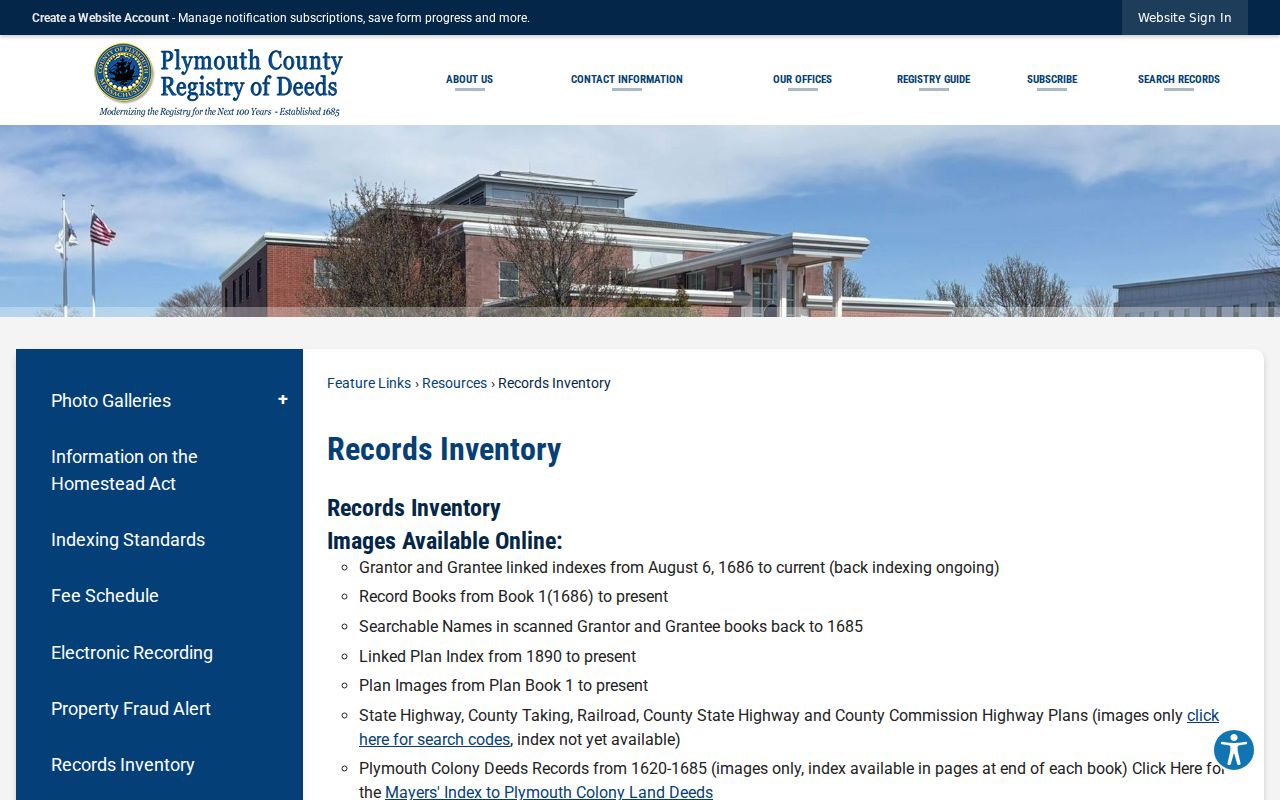
The inventory image points to coverage planning, not a finished chain of title. Open each relevant image in TitleView, then retain the instrument type, recording date, parties, book/page or document reference, and any cited prior deed or plan. A visible index line is a lead. The document image is the point at which a party role and legal description can be checked.
Recorded Land offers Name Search, Book Search, Unindexed Book Search, Date Range, Document Search, and Property Search. If a record belongs in registered land, switch to the separate Registered Land or Certificate Search path. Plans also have their own name, book, date, and plan-number routes. Search and viewing are free; the Registry’s copy channels are available when a certified or regular copy is needed.
Plymouth Historic Grantor Records
The Plymouth historic grantor and grantee menu covers 1685–1969. Use this Plymouth route when the trail reaches an older instrument, an unindexed book, or a name that does not resolve through a modern search path. A grantor is the party transferring an interest. A grantee is the party receiving it. Those roles identify the direction of one document; neither word means that the party lived at the address.
Search variants should be grounded in a source. Use a spelling shown in a deed, directory, probate paper, or card, and retain the form searched. When a result is missing, test Book Search, Unindexed Book Search, a date range, document type, property route, both party directions, and the office route. A failed name search is not a finding that no record exists. Historic indexes can also lead to an image that needs its own reading before it is used in the chain.
Trace Plymouth Previous Residents Backward
A chain of title is the sequence of recorded instruments that transfer or affect the legal interest in a parcel. It is not a household list. Start with today’s assessor reference, verify the matching deed image, and move one transaction at a time. Keep a simple table outside the search session with the party roles, instrument, date, book/page or document number, parcel or legal-description wording, image checked status, and every unresolved gap.
- Pull the current parcel card and retain the property location, Parcel ID, sale date, legal reference, and assessment-year label.
- Use the book/page or party reference in TitleView. Confirm the instrument type, recording date, grantor, grantee, legal description, and referenced prior deed or plan in the image.
- For the earlier transfer, search the seller from the current deed as a grantee, because that person or entity may appear as a buyer in the prior instrument.
- Repeat the verified sequence backward. Check predecessor parcel IDs, subdivision plans, trusts, estates, mortgages, certificates, and unindexed books when the chain changes shape.
- Move to the historic grantor/grantee indexes, Registry office route, or relevant probate source when the online path no longer resolves the next document.
- Grantor
- The party shown as transferring a recorded interest in an instrument.
- Grantee
- The party shown as receiving that recorded interest.
- Chain of title
- A documented sequence of property instruments, checked link by link rather than assumed from names alone.
- Legal description
- The parcel wording in an instrument or plan. It can remain useful when street labels, units, or parcel numbers change.
Note: A chain can have gaps from unindexed books, parcel changes, registered land, or an unconfirmed image, and each gap should remain visible.
Plymouth Colony Record Boundary
Plymouth Colony material is a specialized historical route, not an automatic extension of every house history. TitleView’s volume key reaches the settlement period, with parts covering 1620–1651, 1651–1663, 1664–1674, 1674–1681, and later seventeenth-century ranges. The Registry’s inventory describes Plymouth Colony deeds from 1620–1685 as images with an index at book ends. Read the volume label, image, and transcription carefully before treating a colony reference as part of a modern parcel chain.
The historical setting is useful because Plymouth streets around Town Square and Leyden Street developed early, but geographic familiarity is not proof that two addresses are the same place. Compare deed boundary language, a recorded plan, a map sheet, and a source with a date. If the linkage remains uncertain, describe it as a possible research lead rather than a connection.
Date a Plymouth Building Carefully
Maps and building fields add an interest layer to a house history when they are read as dated evidence. The Library of Congress holds Plymouth’s March 1891 Sanborn set of nine sheets. A Town historic-district report cites Sanborn maps for 1901, 1906, 1912, 1919, 1927, 1948, and 1961 for one documented property. A sheet can show a footprint, use, street label, or nearby features at that moment. It does not identify a present occupant or make a later parcel boundary certain.
Plymouth assessor cards can show building year, style, foundation, roof, units, and other appraisal fields. They are useful clues, not an architectural survey. Pair them with the Historic Houses Collection, MACRIS, a Sanborn image, or a primary record when the detail matters. This approach lets past-residents research preserve a building’s history without converting an appraisal label into a personal claim.
Plymouth Previous Residents in Directories
Deeds identify property parties. Dated directories and newspapers can add the household layer, but each source has its own scope. The Massachusetts State Library inventory lists Plymouth directory years from 1887–1888 through 1932, with gaps, plus selected voting lists and a 1960 pocket directory. An explicit Plymouth reverse-directory title was not confirmed for every year. Request the title page, exact entry, page, and any house or street guide before saying what a volume contains.
Pair the closest directory edition with a census source available for the same period, then compare the street spelling and address against the deed and map trail. Keep the flow narrow:
dated directory entry → matching-period census source → newspaper or obituary lead → permitted vital, cemetery, or probate corroboration
The Plymouth City Directory path is the place to inspect the collection years and access rules in depth. For an address history, use only the edition that falls near the recorded transfer, and state the exact relationship the entry supports.
Plymouth House Files and Maps
Plymouth Public Library’s local-history resources include the Bartlett Room, Plymouth Collection, History Room, maps, newspapers, annual reports, yearbooks, and vertical files. The Historic Houses Collection consists of ten binders from a 1992–1995 Massachusetts Historical Commission survey, arranged by place with a street-name index. The files may contain a historic name, builder, architectural description, and time-limited references to residents. History Room access is by appointment, and fragile or non-circulating material may need reference support.
Cross-check a house file with MACRIS, deeds, directory editions, and the map record. Plymouth Antiquarian Society archives can also provide family papers, books, journals, and photographs by appointment. Pilgrim Hall Museum’s library is strong for historical context but explicitly says it does not contain genealogical materials. Each institution has a different access mode, so record the collection name, box or binder, date span, and restriction rather than treating them as interchangeable.
Note: A photograph, yearbook, newspaper notice, or burial record can support historical context but needs corroboration before it is described as a residence.
Protect Plymouth Previous Residents
Historical research needs a privacy boundary. Massachusetts Address Confidentiality Program participation, confidential voter registration, sealed or impounded court material, vital-record access rules, and public-record exemptions can withhold or replace information. Do not infer a protected person from a blank result, substitute address, redacted record, or old reference. Keep dates of birth, voter identifiers, phone numbers, email, signatures, Social Security numbers, and protected addresses out of an address-history record.
Lawful use. Plymouth previous-residents research is appropriate for family history, estate questions, property history, and personal curiosity. Never use a past address trail to stalk, harass, intimidate, or harm a living person.
Use source-level remedies when a record needs correction or protection. The Massachusetts Address Confidentiality Program, confidential-voter rules, court procedures, and agency redaction routes are documented official channels. A missing result remains a limit, not an invitation to fill the gap with an unverified commercial copy.